Home Theater to Headphone So I Can Watch Movie When Baby Is Sleeping
Can you learn in your slumber?

Slumber learning used to be a pipage dream. Now neuroscientists say they accept found means to raise your memory with your eyes airtight, says David Robson.
J
Just before y'all climb under your duvet, you carefully prepare your room. You sprinkle a few drops of incense on your pillow, put on some headphones, and place a strange-looking band over your scalp. So y'all go to sleep. The ritual takes just a few minutes, but you hope this could advance your learning of a diverse range of skills: whether you are trying to master the pianoforte, tennis or fluent French. You won't recall a single aspect of the night's "training" – but that doesn't matter: your performance the next morning should be ameliorate, all the same.
The idea of learning as you sleep was in one case thought very unlikely, but there are several ways – both depression- and hi-tech – to endeavour to assist you acquire new skills every bit you doze. While there is no method that will let y'all to acquire a skill completely from scratch while you are unconscious, that doesn't mean that y'all still tin can't use sleep to heave your memory. During the night, our brain busily processes and consolidates our recollections from the day before, and at that place could exist ways to enhance that process.
Given that we spend a third of our lives in the country of nod, it is little wonder that sleep learning has long captured the imagination of artists and writers. In most incarnations, it involved the unconscious mind arresting new data from a recording playing in the background. In Aldous Huxley's Brave New Earth, for case, a Smooth male child learns English subsequently having slept through a radio lecture past George Bernard Shaw; the authoritarian authorities presently uses the aforementioned technique to brainwash its subjects. More recently, in The Simpsons, Homer buys a record to subliminally reduce his appetite as he sleeps, merely to detect that it is instead changing his vocabulary. When his wife, Marge, asks if his diet is working, the ordinarily inarticulate Homer replies: "Lamentably, no. My gastronomic rapacity knows no satiety".
Bad science
In reality, this particular kind of sleep learning is almost certainly incommunicable. Although some early studies suggested that subjects could pick up some facts as they slept, the researchers couldn't exist sure that they hadn't just awoken to listen to the recording. To test those suspicions, Charles Simon and William Emmons fastened electrodes on the scalps of their subjects, allowing them to be sure that they only played the tapes once the subjects were dozing. Every bit they had suspected, the subjects learnt nothing in one case they had dropped off. The results were published in the 1950s, but entrepreneurs over the years accept still tried to cash-in on the attraction of effortless learning with various products – even though their methods had no scientific ground.
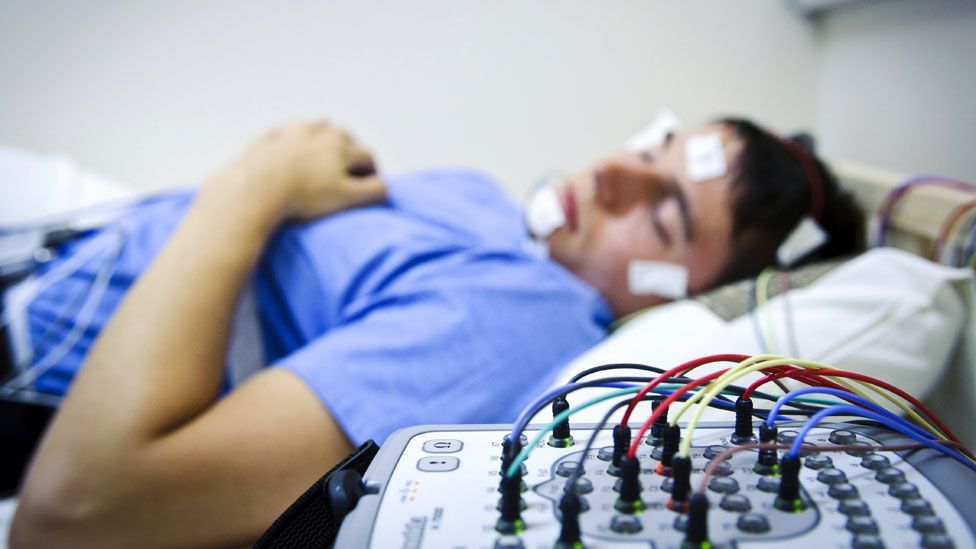
Monitoring encephalon activity of sleeping people suggests they can't learn new skills while unconscious (SPL)
Despite being blind and deaf to new information, notwithstanding, the sleeping brain is far from idle: information technology mulls over the day's experiences, sending memories from the hippocampus – where memories are first thought to course – to regions across the cortex, where they are held in long-term storage. "It helps stabilise the memories and integrate them into a network of long-term memory," says Susanne Diekelmann at the Academy of Tubingen in Federal republic of germany. Sleep also helps us to generalise what nosotros've learnt, giving us the flexibility to use the skills to new situations. So although you tin can't soak up new material, you might instead exist able to cement the facts or skills learned throughout the day.
Smell enhancer
So far, at least four methods accept shown hope. The simplest strategy harks back to the research of a 19th Century French nobleman named the Marquis d'Hervey de Saint-Denys. Equally he explored ways to directly his dreams, the Marquis found that he could bring dorsum sure memories with the relevant smells, tastes or sounds. In one experiment, he painted a scantily clad woman while chewing an orris root; when his retainer then placed the root in his mouth equally he slept, the tart flavor brought back visions of the aforementioned beautiful lady in the entrance hall of a theatre. She was wearing "a costume that would have hardly been acceptable to the theatre committee", he wrote with delight in his book, Dreams and How to Guide Them. Some other time, he asked the conductor of an orchestra to play sure waltzes whenever he danced with two particularly attractive women. He and then rigged upwardly a clock to a music box, so that information technology played the same tunes during the night, which patently brought their handsome figures to his sleeping mind.
The Marquis simply wanted to seed his slumbers with pleasant (and sometimes lustful) experiences, but it now looks similar the same approach can also trigger the sleeping encephalon to replay the learning of skills or facts, reinforcing the memory in the process.

Diekelmann, for instance, asked her volunteers to play a variation of the game Concentration, in which they had to larn a specific design of objects in a grid before going to slumber in her lab. Some of the subjects were exposed to a subtle, artificial, aroma as they played, and Diekelmann then wafted the aforementioned scent into their noses as they slept. Brain scans showed that these subjects had greater communication betwixt the hippocampus and several cortical areas, compared to those without the cue – but the kind of activity that should lead to enhanced retentiveness consolidation. Certain enough, those subjects remembered about 84% of the object locations when they awoke, while a command group remembered only 61%.
It'southward non just sweet smells that could heave learning; as the Marquis plant with his night-time waltzes, sounds might besides be able to trigger recall, provided they exercise not wake you upwards in the process. In ane study, volunteers found it easier to chief a musical game (a little like Guitar Hero) if they heard soft strains of the melody every bit they slept. Bjorn Rasch at the University of Zurich, Switzerland, meanwhile, plant that the aforementioned setup helped Swiss German speakers learning Dutch vocabulary, allowing them to remember well-nigh 10% more than.
Tech upgrade
In the most future, technology may offer further ways of upgrading the brain's slumber cycles. Memory consolidation is thought to occur during specific, slow, oscillations of electrical activity, so the idea here is to subtly encourage those brain waves without waking the bailiwick. Jan Born, at the University of Tubingen, has been at the forefront of these experiments. In 2004, he establish that he could assist amplify those signals using transcranial direct current stimulation (tDCS), which passes a small electrical current across the skull, successfully improving his subjects' performance on a verbal memory examination.
More recently, he has turned to an even less-invasive grade of stimulation, which uses a skullcap of electrodes to mensurate neural action, while headphones deliver sounds that are in sync with the brain waves. Born compares the auditory stimulation to the tiny push button that you might give a child on a swing, and then that it gently enhances neural activeness that is already present in the brain. "Yous deepen the ho-hum wave sleep and make it more intense," says Born. "Information technology'due south a more than natural way of getting the system into a rhythm," he says.

If the idea of going to slumber with a cumbersome headset doesn't appeal, Miriam Reiner at the Technion Institute of Engineering science in Haifa, Israel may take a more bonny solution. She hopes to use a class of neurofeedback, which allows subjects to control their neural activeness while awake. In her setup, an electrode fastened to the field of study'south head feeds into a unproblematic computer game, in which the subject is advised to bulldoze a car with the power of their thoughts.
When the electrode records the correct frequency of brainwaves, normally associated with retention consolidation during sleep, they accelerate; when they don't, it slows down. Information technology typically takes merely a few minutes for the subjects to start revving up the right brainwaves – and the alter in listen ready is palpable, says Reiner. "I feel kind of relaxed – like when you're in a garden or walking along beach. Information technology's only similar being in a serene beautiful place." The thought is to kick-commencement memory consolidation directly after learning, which and so gives the sleeping brain a head-first as it sets about reorganising the day'south events. "You create a seed that then grows during the dark," says Reiner.
Play a tune
To test the bear on on learning, her subjects first learned a complex sequence of finger movements – a little like learning to play a tune on the piano – before taking 30 minutes of neurofeedback. The benefits were immediate – directly after the training they were about 10% meliorate than the controls, suggesting the estimator game really had begun to stabilise their memories as if they were really asleep. Chiefly, the improvements continued to abound as they were tested throughout the following week, supporting her theory that neurofeedback could assist memories to blossom equally you slumber.
Needless to say, we will need to see bigger trials with many more subjects before these techniques should be recommended for everyday use. Since the experiments have so far used somewhat artificial tests of learning and memory, it would too be useful to come across how they fare on more useful tasks; Reiner is beginning to take a few steps in this direction by testing whether her neurofeedback tin aid students learn the guitar. Diekelmann also thinks that nosotros demand to confirm that these memory hacks don't take unexpected consequences. "If you lot enhance one prepare of memories, perhaps you lot'd impair another set up," she says.

Sounds and melodies tin can consolidate retentiveness (Thinkstock)
And we shouldn't shy away from the issues highlighted past fiction like Dauntless New World and The Simpsons, she says. Although she doesn't think that these methods could exist used for brainwashing people against their will, she thinks nosotros still need to question whether information technology would be right to showtime manipulating their children'southward memories, for case, in these ways. "Sleep is a vulnerable land." But she's keen to stress that these potential bug shouldn't deter interest in sleep learning. "It's very worthwhile. We but need to use it as responsibly as possible."
Easy tricks
Once those questions have been addressed, there shouldn't be besides many practical hurdles for people who wish to use the techniques for themselves, says Diekelmann. Many of her students and colleagues have already found that sensory cues during sleep tin help them swat-up for exams. "It's very easy to apply," she says. And you lot can now buy EEG kits that work with your smartphone, potentially opening the door for games that assist you lot boost retention consolidation. Even the hardware for sure forms of tDCS became commercially available last year, which could lead to kits designed to meliorate sleep learning.
Farther evidence will be needed to show that the commercial kits can provide the benefits seen in the laboratory experiments, but Born is optimistic. "I retrieve it's only a affair of fourth dimension before it is used as a cognitive enhancer," he says.
At the very least, the research could change the way we view this often nether-appreciated role of our lives. Slumber tends to exist considered an unnecessary down-time that we try to conquer with coffee or Red Balderdash; we are all driven by the need to squeeze the solar day for every terminal drop of productivity. But we may take more time to catch 40 winks if we know that the most profitable part of the mean solar day really could involve doing nothing at all.
If you would similar to comment on this, or annihilation else yous accept seen on Future, caput over to our Facebook or Google+ folio, or bulletin us on Twitter .
Source: https://www.bbc.com/future/article/20140721-how-to-learn-while-you-sleep
0 Response to "Home Theater to Headphone So I Can Watch Movie When Baby Is Sleeping"
Post a Comment